
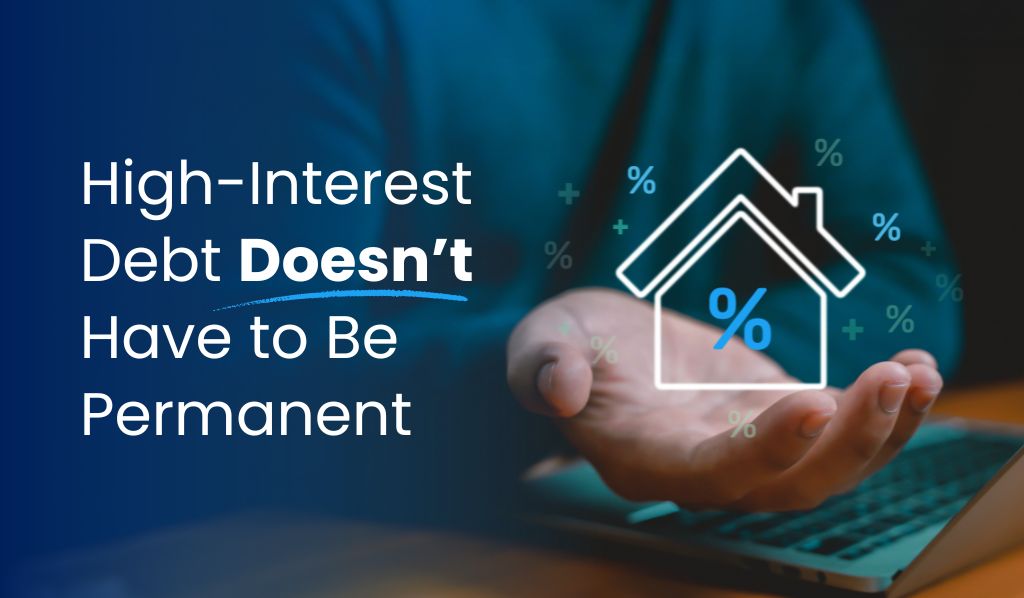
Credit card debt in the U.S. has reached record levels, and interest rates on revolving balances are hovering near historic highs. For many households, balances that once felt manageable have quietly turned into long-term financial headwinds.
If you’re a homeowner carrying high-interest debt, this is a good time to take a closer look at your overall financial strategy, particularly the role your home equity might play.
The Challenge of High-Interest Debt
Today’s credit card interest rates commonly exceed 20%. When balances roll over month after month, interest compounds quickly, making it difficult to make real progress—even for borrowers who consistently pay more than the minimum.
Much of today’s credit card debt isn’t driven by discretionary spending. It’s often tied to:
- Everyday living expenses
- Home and auto repairs
- Medical bills
- Short-term financial gaps
Over time, these high-interest balances can restrict cash flow and limit flexibility.
Why Home Equity Is Part of the Conversation
Home equity is the difference between what your home is worth and what you owe on your mortgage. For many homeowners, it represents one of their largest financial resources.
In certain situations, accessing a portion of that equity can be a strategic way to address higher-interest debt.
A cash-out refinance replaces your current mortgage with a new loan that includes additional funds at closing. Those funds can be used to pay off existing debts, including credit cards—potentially converting multiple high-interest payments into one structured obligation with a lower interest rate.
When a Cash-Out Refinance May Make Sense
This approach isn’t right for everyone, but it may be worth evaluating if:
- You have sufficient equity in your home
- Your credit card interest rates are significantly higher than current mortgage rates
- You want to simplify multiple monthly payments
- You plan to stay in your home long enough to offset refinancing costs
- You’re committed to avoiding future high-interest debt
Used thoughtfully, this strategy can improve monthly cash flow and help reduce long-term interest expense.
A Tool—Not a Shortcut
Because your home is involved, this decision deserves careful consideration. Factors like loan terms, closing costs, and long-term financial goals all matter.
Home equity can be a powerful financial tool—but it works best when paired with a clear plan and disciplined budgeting.
Quick FAQs
Is a cash-out refinance the same as a home equity loan?
No. A cash-out refinance replaces your existing mortgage, while a home equity loan is a separate second loan. Each option has different benefits depending on your situation.
Does using home equity to pay off debt hurt my credit?
Paying off high-balance credit cards can actually improve your credit profile in some cases, but results vary. It’s important to look at the full financial picture.
Does it still make sense with today’s mortgage rates?
It depends. Even with higher mortgage rates, the gap between mortgage interest and credit card interest can still be meaningful. The math—and your timeline—matter.
Final Thought
Record credit card debt has made high-interest balances harder to ignore. For homeowners, home equity may offer an opportunity—not as a quick fix, but as part of a more intentional financial strategy.
Understanding your options is the first step toward making smarter, more confident decisions.
Get in Touch
If you’re thinking about buying, refinancing, or just want a clear plan for the year ahead, use the contact form below and a Highlands loan officer will walk through it with you.